
[FEATURED_IMAGE]
At 02:14 local time, while most of us were dreaming about zero-days, an eighteen-year-old rifleman snapped a selfie. Two hours later, the picture was on Instagram. By sunrise, every hostile cell in northern Syria knew exactly which village the raid had hit, the approximate unit strength, and the direction the assault team exfil’d. Welcome to the age of military social media leaks, where one careless post can torch operational security faster than a compromised satellite uplink.
If you work military & defense contracts, you already feel the migraine. A single operator’s dopamine rush can evaporate months of planning, endanger civilians, and hand propaganda wins to adversaries. Today we’re ripping the scab off how open-source intelligence (OSINT) analysts weaponize those selfies, what contractors can do to plug the hole, and why the problem keeps metastasizing faster than a crypto-miner in a Docker container.
From Face-Swap to Fiasco: Anatomy of a Selfie Leak
Most soldiers aren’t trying to betray their unit. They’re bored, proud, and addicted to the dopamine hit of likes. Unfortunately, the metadata in a snapshot—GPS, time-stamp, device ID—creates a targeting package more precise than a Javelin fire-control system.
Here’s what typically slips out in under five seconds:
| Data Point | What the Enemy Gains |
|---|---|
| GPS Coordinates | Exact objective location |
| Time-Stamp | Tactical timeline, dwell time |
| Face Recognition | Unit identification via open personnel databases |
| Background Structures | Geolocation via free satellite imagery |
| Hashtags (#deploymentlife) | Sentiment analysis, troop morale, rotation schedules |
Multiply that by ten soldiers posting within minutes of each other and you’ve built a heat-map of classified movement patterns—no SIGINT budget required. How Military Teams Use OSINT to Boost Threat Intelligence and Battlefield Awareness dives deeper into turning the same open sources against the adversary.

How Investigators Reconstruct a Raid from Public Photos
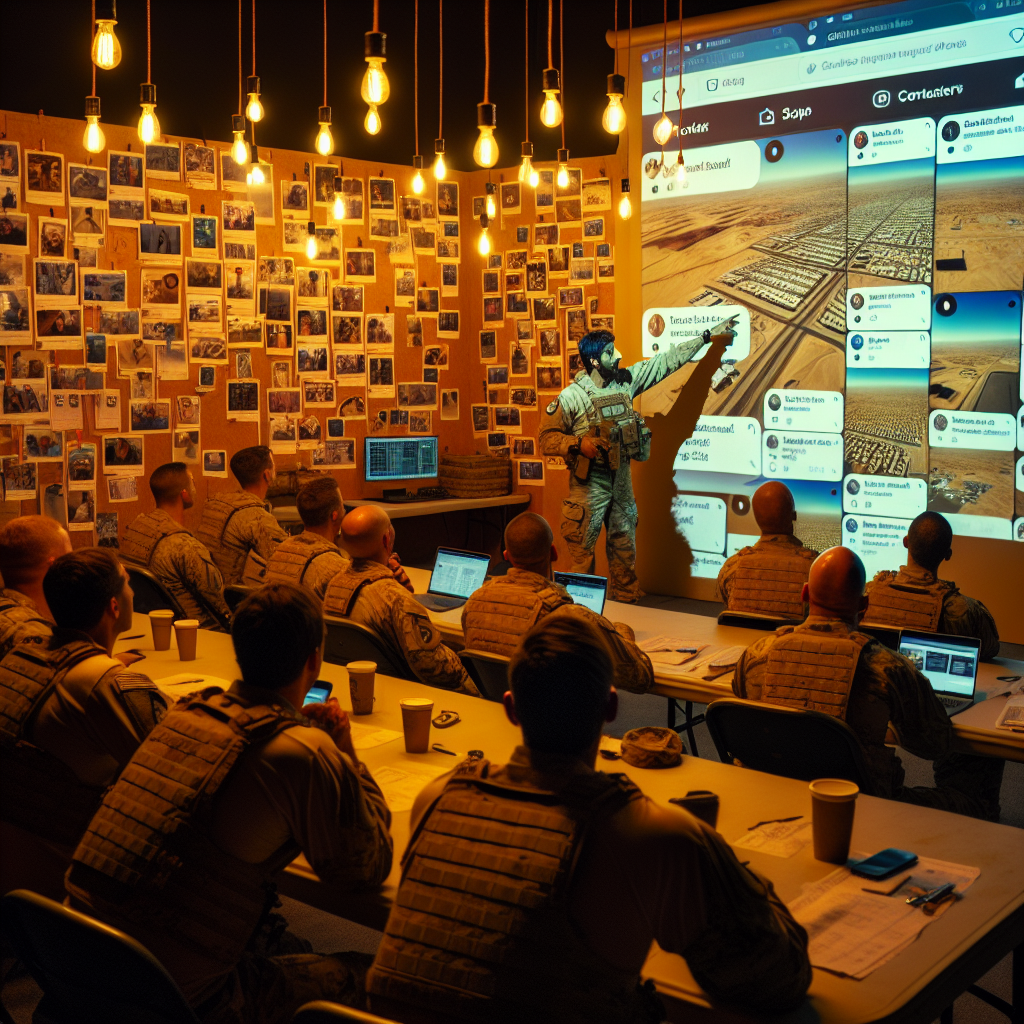
Forget Hollywood CGI. A competent analyst can triangulate the truth using nothing more than free imagery, time-zone math, and a spreadsheet:
- Scrape Telegram, Instagram, TikTok for geotagged posts inside the target box.
- Extract EXIF GPS or match background objects to satellite tiles.
- Cluster uploads by time to build a temporal pattern.
- Enrich with shadow angles & star positions to confirm exact hour.
- Cross-reference with flight-tracking ADS-B data for helo routes.
- Publish findings to Telegram channels monitored by every faction on the ground.
All six steps finish before the unit’s after-action review hits the first PowerPoint slide. OSINT wins the race because it travels at fiber-optic speed, not bureaucratic speed.
Contractor Checklist: Stop a Night-Raid Leak Before It Happens
Defense contractors can’t stop selfies, but you can make them worthless:
- Pre-Deployment Training: Show real examples of soldiers whose posts got their buddies shot. Emotional impact beats PowerPoint acronyms.
- Device App Lock-Down: Disable GPS tagging on cameras, enforce MDM policies, and whitelist only approved social apps.
- Social Media Red-Team: Task red teams to scrape your own troops, then brief the unit on what they found. Red Team OSINT Reconnaissance Guide gives you the play-by-play.
- Rapid Takedown Agreements: Pre-negotiate with platforms so a flagged post disappears in minutes, not days.
- OSINT Fusion Cell: Blend imagery analysts, linguists, and data scientists to watch for leaks the way you watch for incoming mortars.
Tool Time: Automating the Hunt for Leaks
Manual scraping doesn’t scale when you’re covering an entire AOR. That’s where Kindi earns its keep. Our AI-driven platform ingests millions of images an hour, strips metadata, matches faces against known personnel, and flags geofence violations in real time. Analysts collaborate in shared workspaces, link related posts into entity graphs, and export intel packages straight to C2 systems—all without writing a single Python script.
Kindi’s NLP modules also track adversary Telegram channels so you can watch your own leaked footage propagate through militant networks. Nothing builds OPSEC discipline faster than showing a private how quickly his selfie ends up on an enemy smartphone.
Case File: The Deir ez-Zor Raid That Lit Up TikTok
March 2024: Coalition special operations hit an HVT compound along the Euphrates. Within 23 minutes, local teens posted TikTok clips of rotor wash shaking date palms. Analysts stitched together three clips to derive:
- Approach heading of MH-47s (from shadow direction)
- Landing zone coordinates (roofline matched to Bing 3-D)
- Assault duration (video timestamps)
- Exfil direction (dust cloud vector)
Enemy fighters uploaded the fused intel to their ops channel before the assaulters even reached the FARP. The next planned raid on the same network was scrubbed because planners knew the cat was out of the bag.
Budget-Friendly Mitigations for Small Teams
Big-data platforms are nice, but sometimes you’re stuck with a corporal, a laptop, and a caffeine ration. Here’s how to punch above your weight:
- Browser Extensions: Use InVID or Amnesty YouTube downloader to pull frames & metadata.
- Open-source Geolocation: Suncalc.org plus Google Earth Pro gives you sun azimuth to verify time.
- Face search: Try free engines like pimeyes.com to find duplicate images across platforms.
- Alert Automation: Create IFTTT applets that email you when new posts appear inside a specified map area.
For a deeper dive on budget tooling, Automating OSINT Investigations breaks down which tasks to script and which to leave human.
Legal Quick Sand: What You Can (and Can’t) Do
American forces enjoy First Amendment protection; foreign partners may not. Before you start mass-scraping personal devices, confirm:
- Status-of-forces agreements allow digital searches
- Your collection meets host-nation privacy law
- Chain-of-custody for scraped evidence holds up in court
- Command authority supports punitive action if policy is violated
Skipping these checks turns your OPSEC crackdown into a diplomatic incident faster than you can say “SOFA violation.”
Future Shock: AR, Deepfakes, and the Next Generation of Leaks
Smart glasses with live-streaming are already on Amazon. Add deepfake filters that swap uniforms and you’ve got a propaganda blender nobody asked for. The countermeasure playbook stays the same: rapid detection, automated takedown, and relentless education. The only thing changing is the speed requirement—measured in heartbeats, not hours.
Bottom line: if your security model assumes privates won’t post, you’re gambling with lives. Build processes that treat every deployment like it’s already on TMZ, and you’ll sleep a lot better.
FAQ
- Q: Can’t we ban phones outright?
A: Good luck with morale or retention. Better to control, monitor, and educate than to create a black market for selfies. - Q: Do encrypted messaging apps solve the problem?
A: Nope. Recipients can screenshot and forward. Encryption protects transport, not human behavior. - Q: What if GPS is disabled?
A: Background landmarks, Wi-Fi SSIDs, and even power-line configurations can place you within meters. - Q: How fast can Kindi detect a leak?
A: Our benchmark: geotagged posts flagged inside an AOR within 90 seconds of upload. - Q: Are there legal ways to scrape service-member data?
A: Yes, for official use when policy and local law authorize it. Always coordinate with JAG first.
Want to strengthen your OSINT skills? Check out our free course
Check out our OSINT courses for hands-on training.
And explore Kindi — our AI-driven OSINT platform built for speed and precision.